 Archives
 Prescribed Fire (fs.fed.us)
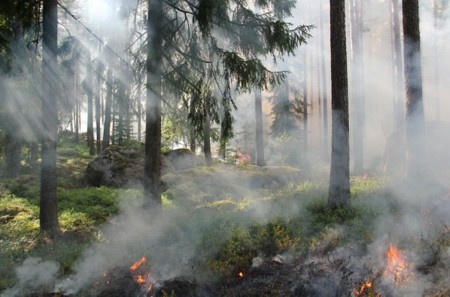
04-04-2016 - Did you know fire can be good for people and the land? After many years of fire exclusion, an ecosystem that needs periodic fire becomes unhealthy.
20 articles
Archives 04-04-2016 - Did you know fire can be good for people and the land? After many years of fire exclusion, an ecosystem that needs periodic fire becomes unhealthy.
16 March 2016 - Forest concepts and definitions in the era of forest and landscape restoration
 Archives
 Forest Digest – Week of March 14, 2016 March 18th, 2016 by American Forests Find out the latest in forestry news in this week’s Forest Digest!
14 September 2012 - 1. Acknowledging the contribution forests can make to rural development through the provision of secure employment with competitive incomes,....
The Green Belt Movement has two divisions. Green Belt Movement Kenya and Green Belt Movement International.
Over 30 nesting sites of White-necked picathartes have been recorded The Gola forest at 750 square km (300 square miles) is Sierra Leone’s most important and most diverse forest. The Forest is a fragment of a once extensive forest belt that stretched across West Africa, commonly know in conservation circles as ‘The Upper Guinea Forest’.
To build on a commitment taken at the World Summit on Sustainable Development, in May 2003 the Commission published an EU Action Plan for Forest Law Enforcement, Governance and Trade (FLEGT). Council Conclusions were adopted in October 2003, and the European Parliament motion on the FLEGT action plan was adopted in February 2004.
European Parliament resolution on speeding up implementation of the EU action plan on Forest Law Enforcement, Governance and Trade (FLEGT)
Benedek Jávor – László Gálhidy Hungarian forests: ecology and conservation, February 2005 Published by FERN, February 2005. FERN: 1c Fosseway Business Centre, Stratford Road, Moreton-in-Marsh GL56 9NQ, United Kingdom. Tel: 00-44- 1608 652895. Fax: 00-44-1608 652878. Email: info@fern.org Web: www.fern.org
Background paper for the Country-Led Initiative in Support of the UNFF “Scoping for a future agreement on forests” Berlin, Germany 16-18 November 2005. by Richard G. Tarasofsky Head, Energy, Environment and Development Programme Chatham House Lauren Flejzor PhD. Candidate, London School of Economics and Political Science Energy, Environment and Development Programme Chatham House 10 St James Square, London SW1Y 4LE, UK www.chathamhouse.org.uk/eedp eedp@chathamhouse.org.uk © Royal Institute of International Affairs 2005 This material is offered free of charge for personal and non-commercial use, provided the source is acknowledged. For commercial or any other use, prior written permission must be obtained from the Royal Institute of International Affairs. In no case may this material be altered, sold or rented. Credit: © Royal Institute of International Affairs 2005 Executive Summary This background paper aims to inform the discussions at the Country Led Initiative in Support of the UN Forum on Forests (UNFF) “Scoping for a future agreement on forests”, in Berlin, Germany, 16-18 November 2005. The paper surveys and analyses various non-binding “soft law” instruments in the internati
Published by the International Institute for Sustainable Development (IISD) Vol. 110 No. 5 Sunday, 26 November 2005 SUMMARY OF THE EUROPE AND NORTH ASIA FOREST LAW ENFORCEMENT AND GOVERNANCE MINISTERIAL CONFERENCE: 22-25 NOVEMBER 2005 Over 250 ministers, representatives of government, intergovernmental and non-governmental organizations and research agencies from 48 countries convened in St. Petersburg, Russian Federation from 22-25 November 2005 for the Europe and North Asia Forest Law Enforcement and Governance (ENA-FLEG) Ministerial Conference.
 Archives
 Statement by Fülöp Benedek State Secretary, Chairman of the Hungarian National FAO Committee Ministerial Meeting on Forests Rome, Italy,14 March 2005 Mr. Chairman, Mr. Director General, Distinguished Guests, Ladies and Gentlemen, It is my great pleasure to greet, on behalf of the Government of the Republic of Hungary the ministers, delegates and guests attending the Ministerial Meeting on Forests.
Tisza River The most significant medieval collection of customary law in Hungary, the Tripartitum by Werbőczy (1521), provides evidence that the diversion of waters, flood control measures and the construction of mill-ponds was common practice as early as the 13th century. Another purpose of these early hydrological measures was to make rivers navigable, making it possible to float timber from the mountains and to ship the products of the royal salt mines in the Carpathian Mountains. An expansion of the population during the 18th century increased the demand for grain. To meet this need, extensive herding was gradually replaced by the production of field crops, and forests were converted to fields.
 Archives
 Prompted by the results of extensive, careful preparatory studies, the government has adopted on the 15th of October, 2003 a decision on the most ambitious rural development program of past decades. According thereto, in Stage I of the new Vásárhelyi Plan (abbreviated in Hungarian as VTT), which covers the period terminating with 2007, six emergency reservoirs would be built along the Upstream- and Middle Tisza sections to enhance the level of flood safety in the region. The program reflects a new government philosophy, in that it takes as far as possible into consideration the interests of environmental protection and nature conservation.
"Forest fires in Southern Europe - From prevention to restoration" (Cyprus, France, Greece, Italy, Portugal, Slovenia and Spain) 24-25 January 2005, Brussels Section 5: 2003 and 2004 forest fires in relation to policy tools and organisation, sharing experiences. Forest fire prevention and rural development programmes in the European Union Tamas SZEDLAK Agriculture and Rural Development Directorate-General Unit F1. Environment and Forestry European Commission Ladies and Gentlemen, The number of forest fires and their effects were particularly severe in the last two years in Southern Europe, as it was mentioned in the previous presentations. There were more than 54.700 fires in 2003, with more than 730.000 hectares burnt areas in this part of Europe. The experience gained from these events should be used for improving prevention and restoration measures in the future. I would like to summarise the measures that the EU has put in place in the area of forest fire protection under the Council Regulation (EEC) No 2158/92 of 23 July 1992 on protection of the Community's forests against fire, as well as in the rural development programmes. The Community by means of Council Regulation (EEC)
Brussels, 23 July 2003 What is the Kyoto Protocol? The United Nations Framework Convention on Climate Change (UNFCCC) and its Kyoto Protocol provide the only international framework for combating climate change.1 The UNFCCC, the first international measure to address the problem, was adopted in May 1992 and came into force in March 1994. It obliges all its signatories to establish national programmes for reducing greenhouse gas emissions and to submit regular reports, and demands that the industrialised signatory countries2, as opposed to developing countries, stabilise their greenhouse gas emissions at 1990 levels by the year 2000. This goal, however, is non-binding. By differentiating between industrialised and developing countries, the UNFCCC recognises that industrialised countries are responsible for most of the global greenhouse gas emissions and also have the institutional and financial capacities for reducing them. The Parties meet annually to review progress and discuss further measures, and a number of global monitoring and reporting mechanisms are in place to keep track of greenhouse gas emissions.
The forest fires which have devastated large parts of Portugal could be followed by massive soil erosion, environmental campaigners say.